
Microcosmos and tiny imperium
notes towards a theology of model railways

Microcosmos and tiny imperium: notes towards a theology of model railways
The end is nigh, 1:76.2 scale?
The closure of Hattons, and the end of the Warley Model Railway Show in its form at NEC in Birmingham, caused much alarm – some of it since assuaged.
People including, from slightly different parts of the music world, Pete Waterman and Richard Bratby, wrote here and here what model railways mean to them.
I have just, in Zambia, at the age of 45, with the help of my son, got to a somewhat respectable level of, not completeness but ‘being a thing’-ness, a layout on the baseboard my Daddy built for me in West London in 1989 (see proud photo below).
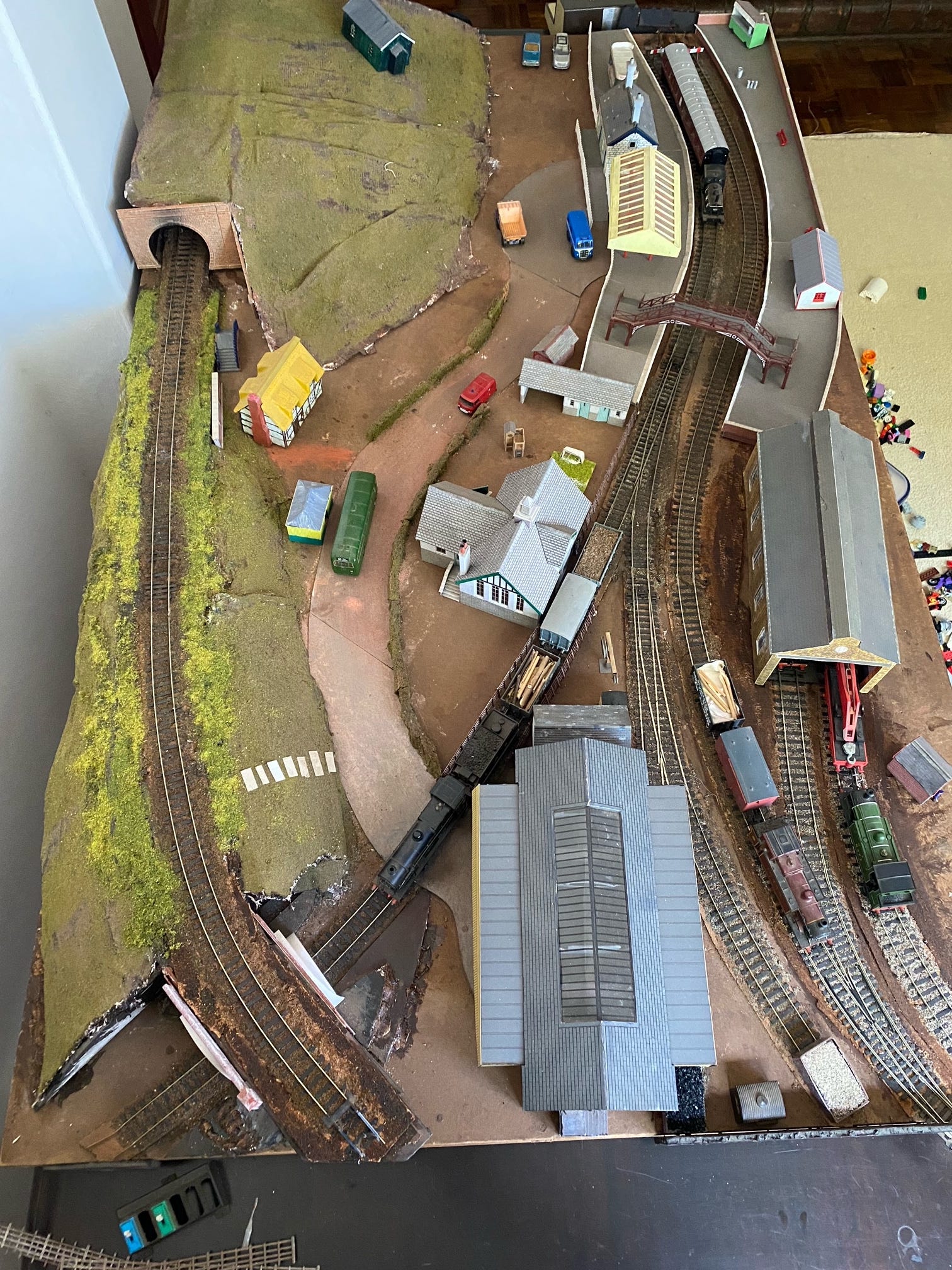
As well as music and model railways – the list also includes Rod Stewart and James Bowman - a thing that a few people remarked upon, and/or had done before, was the overlap between church/clergy/believers and model railways.
There was the Rev Peter Denny and his “Buckingham Branch”; Rev. Wilbert Awdry and the very real model railway, now kept – and still operated – at the Talyllyn Railway in North Wales, that underpinned/accompanied his Railway Series (see this from Mr Tim Dunn and the Talyllyn), and the moral arc of their protagonist, Thomas, and various of his friends, from arrogant unconcern for neighbour and community to becoming ‘Really Useful Engines’.
More recently a Suffragan Bishop had his layour featured in Railway Modeller a little while ago [but my copy is the other end of the world, so I cannot tell you his name], and Revv. Jonathan Bish and Dr Jo Kershaw, whose excellent model of part of the East Coast Main Line you glimpse on twitter between Yorkshire pastoralia.
My sense is that this connection is not negligible, and possibly theologically interesting.
Cosmos and imperium (Sorry Prof. Hardie)
Graham Fawcett, former Director of Psychosocial Services at Thrive Worldwide – a specialist company who deal with the health of missionaries and, particularly nowadays, NGO workers – highlighted two things about model railways (which are, for the avoidance of doubt, his thing, too):
· the order that you have the chance to create on your model railway, even, or especially, if the rest of your existence does not present it
· per contra, that sometimes your model railway may reflect your state of mind: if you are a busy humanitarian and have created a rococo track plan of double slips and helixes, it may be worth having a chat with Thrive sooner rather than later…
Both of these points strike me as true. And I think the first is worth unpackaging a bit further.
Firstly, there is the chance to create, or present, order. Trains that may be cleaner, and more numerous, than in real life. Operating in an order or pattern or timetable, that may be more regular, or more stimulating, than lived experience of South Eastern Trains, or indeed Zambia Railways.
The order frequently involves a rather positive communitarian character: diligent miniature stationmasters and personnel, engines fed and watered by drivers and firemen, passengers in conversation, rather than One-Person-Operation and deserted stations.
Where the mise-en-scène is a bit grittier, the grit often comes attached to a measure of nostalgia for a history that a quick flick of Railway Modeller will show you now runs at least into the early 2000s.
Secondly, there is the pleasure of looking. To model you have to look – and to look harder, because to construct what you see, you first have to, literally, deconstruct it – what is it, what does it do, what is it made of?
And, in looking, you come to appreciate, to value, and even to like, things that would otherwise be as nothing: the stains on, and the weeds in, the ballast; the dust that gradually coats everything; the Network South East red pole holding up the mirror that the driver uses to check the doors are closed; and the lines that aren’t lines any longer, except in the model you are making.
And thirdly, there is the pleasure of things, and the creation of them.
For a lot of us, our jobs are a bit like what + Richard Chartres used to say about some liturgies: the Word was made Flesh, and we have remade it Word, and many of them, too. We farm the emails, mow the lawn of Slack, and generally hammer the keyboard, rather than the gold or the silver. Every year I wonder do I dare to bring a copy of my best powerpoint to Harvest Festival, the ‘First Fruits’ of my peculiar labours?
But making your model railway is different: chickenwire and plaster bandage, Metcalfe card kits and the quietly glorious online subculture around them, filing down flash on plastic kits from fifty year old moulds, the yin and yang of weathering your track work but having the railhead conduct electricity to the trains, so much of it is physical. Either you give your scalpel the direct attention it requires, or, having cleanly and vigorously sliced your finger, you then give it that direct attention.
And all these pleasures are available on unusually even terms to young and old – the enjoyment of operation, the tasks even the smallest can be given, the steady hand with a 000 paintbrush with which the pre-teen supplements the parent and/or grandparent.
So there you have it: 00 gauge as a firm, 16.5mm-width middle finger to the Gnostics and the Arians, and a quietly confident askesis and statement of the Joy of the Gospel, and the goodness of God’s creating spirit, and our imitation of it, in a world that needs it. As Isaiah said, surely anticipating our needs in tracklaying and ballasting: “So the carpenter encouraged the goldsmith, and he that smootheth with the hammer him that smote the anvil, saying, It is ready for the sodering: and he fastened it with nails, that it should not be moved”.